When Do You Advance? Progression Rules After the First Prescription
Three ways to advance an adolescent concussion aerobic prescription—weekly BCTT retest, CISG step rules (24h floor on sport steps only), or session ramps—and whether those rules still apply when return-to-learn and return-to-sport run together. Ideal-document minima are not expected recovery times.
Caution
Not medical advice. Educational use only. Data from published literature.
The prescription landed: walk at 65% age-predicted maximum heart rate, 20 minutes, five days a week. What changes it?
The Leddy/Buffalo group answers: bring the athlete back to the treadmill at the end of the week. Run a BCTT. If the threshold rose, raise the ceiling PMID: 30715132. Micay et al. answers: add approximately 5% HRmax next session, on schedule PMID: 30018795. The CISG consensus answers: for return-to-sport steps, a minimum of 24 hours per step; for return-to-learn steps, no equivalent time floor—only symptom threshold PMID: 37316210. All three are in the adolescent SRC and PPCS literature. None has been compared head-to-head.
The advancement rule matters clinically: it influences whether a student returns to full sport in three weeks or eight. It determines whether a partial school day is a gate or a side note. And in the week when return-to-learn and return-to-sport are both active—a student running PE drills and sitting through exam accommodations—it determines which track holds when symptom load climbs.
This piece assumes you already have a running prescription—intensity, weekly volume, and school/sport steps. What that still leaves open: once a prescription is running, what changes it—and does that rule still hold when school and sport are both active?
No trial defines same-day school-plus-aerobic budgeting, so the SOP checklist below relies on clinical judgment rather than a published rule. No adolescent PPCS trial has randomized progression-rule type either. Three published ways to advance a prescription are mapped below, then checked against the Berlin and Amsterdam consensus PDFs, which show that school and sport steps do not share the same timing rules (consensus table audit; Figure 2).
1. Three progression logics: rules and origins
The literature does not use the term “progression rule” consistently. Some papers describe operational trial visit schedules; others describe clinical conventions derived from those trials without formal derivation. The three logics below span that range.
One scope note before the map: Logic A and Logic C describe when to change an aerobic prescription (HR ceiling or session dose). Logic B describes when to advance a return-to-sport step in the CISG graduated strategy—a different object. In clinical practice, Logic B is routinely borrowed to time aerobic prescription changes because most RTS step 2 activity is the prescription; the two objects often collapse. This paper treats them as one category where they overlap in practice, while noting where the conflation matters.
Three logics at a glance
| Logic | Object | Advance when | Typical setting | Key source |
|---|---|---|---|---|
| A | HR ceiling | Weekly BCTT; outpatient fallback every 2 wk 24225521 | Treadmill clinic | PMID: 30715132 |
| B | CISG return step | ≤2/10, <1 h; RTS also ≥24 h/step | School / community | PMID: 37316210 PMID: 28446457 |
| C | Session dose | Next session completed (+ symptom log) | Structured PT / home ramp | PMID: 30018795 PMID: 27120294 |
Logic B governs steps; A and C govern prescription titration. The figure and SOP below keep that distinction visible.
1.1 Logic A — Weekly BCTT retest (Leddy / Buffalo)
The Buffalo Concussion Treadmill Test (BCTT) was developed as both a diagnostic tool and a prescription anchor. In the foundational RCT PMID: 30715132, Leddy et al. specified weekly physician follow-up and treadmill-based dose adjustment in the Methods section:
“After a first visit, participants were followed up weekly by their physician until recovery or for 30 days.” “A new target HR was determined by weekly clinic BCTT performance for as long as the participant remained symptomatic.”
(JAMA Pediatr. 2019;173(4):319–325, Methods — aerobic exercise group.)
The logic is test-gated: the ceiling does not move until physiologic evidence of readiness is measured. In that trial’s context—weekly visits, treadmill access, research protocol—this is operationally clean. The prescription stays fixed for seven days, the test reruns, and the ceiling adjusts based on where the threshold now sits.
The 2013 BCTT review from the same group PMID: 24225521 softened the retest frequency for outpatient settings:
“increase the exercise HR target by 5 to 10 bpm every 2 wk (via phone call or email)”
The same article specifies 10 bpm every 2 wk for athletes and 5 bpm every 2–3 wk for nonathletes, with optional BCTT repeat every 2 wk for a more precise target. That remains a time-gated rule—no session-by-session titration—but at a cadence clinics without weekly treadmill time can follow.
Leddy 2021 PMID: 34817719 described a stage-ladder fallback for settings between full BCTT access and no structure:
“Patients who exercise for at least 20 min at 50% of HRmax without symptom exacerbation may advance to the next stage (55% of HRmax). If patients experience some worsening of symptoms during exercise at any stage (defined as a 1- or 2-point increase on a 0–10 pain scale compared with their pre-exercise value), they remain at the current stage until they can exercise without symptoms worsening. If patients experience significant worsening (3-point or more increase), the exercise intensity is reduced. Patients are encouraged to keep a diary to monitor their recovery and to be re-evaluated every 1–2 weeks. The goal is to exercise at 80% or more of HRmax without symptom exacerbation.”
This is a session-observed, test-lite variant: it preserves the threshold logic but allows the previous session’s tolerance to stand in for a formal BCTT. Re-evaluation every 1–2 weeks is stated in Leddy 2021 itself—a slightly different cadence from the 2013 review’s every-2-wk HR-target bump—and both are slower than the weekly RCT visit schedule.
Where this logic fits: clinic-based PPCS programs with scheduled weekly or biweekly visits; post-acute concussion with treadmill access; any setting where the clinician will see the patient again before the prescription changes.
1.2 Logic B — CISG step rules (Berlin, Amsterdam)
Logic B governs return-step advance in CISG graduated strategies—a different object from HR prescription titration, though RTS step 2 aerobic work often carries the prescription in practice (see scope note above).
Berlin PMID: 28446457 and Amsterdam PMID: 37316210 pair four-stage return-to-school tables with six-step RTS protocols in the same documents. Both use a shared ≤2/10 for <1 h mild-exacerbation threshold on advance. The clinically operative split is temporal: RTS tables state an explicit per-step time floor; RTL tables do not.
The table below documents that asymmetry directly from Berlin and Amsterdam full text: for each document, it records step count, whether an explicit ≥24 h/step floor appears, where in the document the time rule is located, and the progression gate type. The same four fields were applied to both documents; the asymmetry replicates.
NICE NG232 uses similar symptom-guided step logic without a stated per-step time minimum—consistent with CISG school-step rules, not the sport-step time floor.
RTL and RTP advancement rules from Berlin and Amsterdam full text
Both CISG consensus documents (PMID: 37316210, PMID: 28446457) were read in full. The four rows below cover every RTL and RTS table in both documents.
| Document | Table | Steps | Explicit ≥24 h/step? | Location of time rule | Advancement gate |
|---|---|---|---|---|---|
| Amsterdam 2022 37316210 | Table 1 (RTL) | 4 | No | Absent from title and footer | Symptom only — slow if >mild/brief exacerbation |
| Amsterdam 2022 37316210 | Table 2 (RTS) | 6 | Yes | Table title + footnote | ≥24 h/step + ≤2/10 for <1 h |
| Berlin 2017 28446457 | Table 2 (return-to-school) | 4 | No | Stage text only | Symptom recurrence at stage |
| Berlin 2017 28446457 | Table 1 (RTS) | 6 | Yes | NOTE below table | ≥24 h/step; step back if symptoms worsen |
Replication across documents: Both consensus documents place the explicit per-step time floor on the sport table only; neither RTL table carries an equivalent minimum.
Amsterdam — RTS table title (verbatim):
“Return-to-sport (RTS) strategy—each step typically takes a minimum of 24 hours” PMID: 37316210
Amsterdam — RTL table footer (verbatim; no time floor):
“Progression through the strategy for students should be slowed when there is more than a mild and brief symptom exacerbation.” PMID: 37316210
Berlin — RTS protocol NOTE (verbatim):
“There should be at least 24 hours (or longer) for each step of the progression. If any symptoms worsen during exercise, the athlete should go back to the previous step.” PMID: 28446457
Berlin return-to-school Table 2 lists four stages with symptom-based activity descriptions; no parallel 24-hour sentence appears in that table or its footnote 28446457.
Where this logic fits: community prescriptions, school-based programs, primary care, telehealth follow-up; any setting where weekly treadmill testing is impractical; the default step rules in CISG Berlin PMID: 28446457, Amsterdam PMID: 37316210, and NICE NG232.
1.3 Logic C — Session-titrated prescriptions (Micay 2018; Pittsburgh SE)
Two published PPCS/SRC programs prescribe intensity changes on a within-patient, within-episode calendar rather than at weekly visits or per symptom stability.
Micay 2018 PMID: 30018795 ran a feasibility RCT in adolescent SRC with a structured 8-session ramp:
“The first session lasted 10 minutes, at an intensity of 50% of the participant’s age-predicted maximal heart rate, whereas the following 7 sessions lasted 20 minutes, with intensity increasing by 5% of the individual’s age-predicted maximal heart rate per session.”
The range is 50% to 70% age-predicted HRmax over 8 sessions. This is a fixed ramp: each completed session authorizes the next step, regardless of which day of the week it falls on or whether the BCTT threshold moved. The ramp is written into the trial protocol and carried out by participants at home, with no per-visit clinician adjustment.
Pittsburgh subsymptom exercise (Kurowski 2017) PMID: 27120294 used a different titration model: the clinic bike test identified the duration at which symptoms were first exacerbated, and the home dose was set to 80% of that duration. The dose adjusted at each of six clinic visits:
“Participants were asked to complete their individually tailored cycling program 5–6 days per week at 80% of the duration that exacerbated symptoms during study visits. The cycling program was repeated at each of the following six visits and based on the results, the home exercise program was adjusted for each participant.”
This is a test-gated titration like Logic A, but the progression metric is duration at a fixed effort ceiling, not absolute intensity. The ceiling itself does not step up by fixed percentages; instead the patient builds duration toward a target and intensity is reassessed when the duration target is met.
Where these logics fit: structured PT programs with defined session counts; home programs where the prescription is written for a set number of sessions and changes only at a clinic return; settings where repeated BCTT access is unavailable but session tracking is feasible.
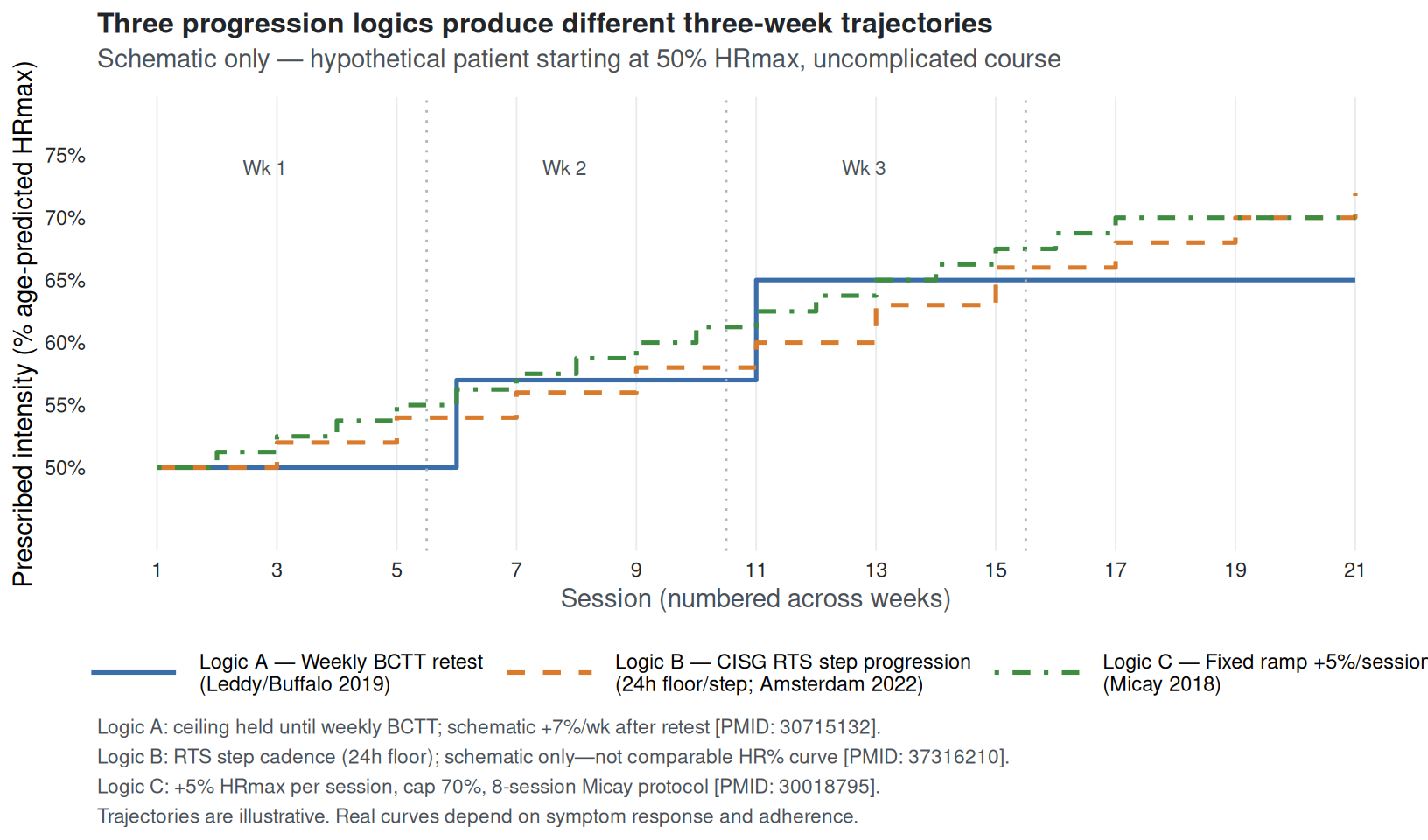
Figure 1 — Three progression paths: hypothetical week-by-week intensity
Figure 1 compares decision rhythm only—not physiological dose. Logic A and C plot prescription intensity (% HRmax). Logic B plots a schematic sport-step cadence; it does not belong on the same y-axis as a heart-rate prescription curve.
Figure 1. All three paths start at 50% HRmax for illustration only. Logic A and C plot prescription intensity (% HRmax). Logic B (dashed) plots a schematic sport-step cadence with a 24 h floor—it is not a heart-rate prescription curve and should not be read against the A/C y-axis as if it were. Logic C advances by session count. Trajectories diverge by week 3 because the advancement rules differ, not because the underlying physiology differs.
2. What drives the choice of progression logic?
No published trial has randomized progression logic type in adolescent PPCS. The assignment in practice follows setting constraints:
| Constraint | Logic that fits | Why |
|---|---|---|
| Weekly treadmill access | A (BCTT retest) | Designed for this workflow; prescription change requires test |
| No treadmill; clinic seen biweekly | A fallback (5–10 bpm / 2 wk; nonathletes 5 bpm/2–3 wk) 24225521 or B | BCTT not available; symptom stability is observable without equipment |
| Structured PT, defined session count | C (Micay or Kurowski duration titration) | Ramp is pre-written; fewer clinical judgment calls mid-program |
| Home / school program only | B (CISG step rules) | No treadmill; daily monitoring by parent or athlete; CISG / NICE NG232 |
| PPCS (>28 d symptoms) | A or C (caution with B alone) | Symptom volatility makes step-by-step symptom gates harder to read day-to-day; structured reassessment preferable |
The clinically dominant logic in North American published guidelines is B (CISG step rules) because the Berlin and Amsterdam consensus documents PMID: 28446457 PMID: 37316210 specify symptom-gated step advance and it requires no equipment. The Buffalo/Leddy group’s original trial logic is A but the 2013 BCTT review PMID: 24225521 already softened it to a 2 wk (nonathletes 2–3 wk) HR-target interval without mandatory weekly BCTT. Micay’s C is the only one with a fixed-ramp RCT design in adolescents, but the sample was 18 participants and the protocol was explicitly labeled a feasibility study.
The takeaway is that the choice of progression logic is largely determined by resource access and visit cadence, not by evidence that one logic produces better outcomes. A practitioner who inherits a patient at 70% HRmax “because that’s where the Micay ramp ended” and then holds that ceiling until a treadmill test is available is mixing Logic C for the ascent and Logic A for the hold—not an unreasonable clinical move, but one the literature has not studied as a hybrid.
One additional constraint from the volume literature: Howell 2021 PMID: 33856860 found that ≥160 min/week was the observational threshold separating symptomatic from asymptomatic students with 81% accuracy on ROC analysis. That threshold describes a volume target rather than a progression trigger, and it implies that advancing intensity may matter less than reaching consistent weekly minutes within any safe intensity band. The CISG RTS step-rule track’s potential for faster ascent (no weekly test required) may not produce better outcomes if the weekly session count is low; RTL’s absence of a time floor adds further variability to combined daily load estimates.
3. The dual-track layer: RTL and RTP do not share an advancement rule
Terminology: RTL = return to learn/school; RTP = return to sport. CISG documents use RTS for the sport table; this piece uses RTP in clinical prose.
RTL and RTP run from different checklists, and the literature seldom tracks combined daily load. The progression question adds a second dimension: does the school track use the same advancement timing as the sport track?
The consensus table audit shows the answer in Berlin and Amsterdam full text: the same symptom threshold, different timing rules on school vs sport tables.
Rule-derived minimum calendar (symptom-ideal scenario)
From the audited tables, a document-only lower bound on calendar days can be calculated by applying each consensus document’s stated rules under ideal symptom stability:
| Assumption | Value |
|---|---|
| Initial relative rest | 24–48 h before step 1 (both documents) |
| Symptom course | No step-backs; ≤2/10 gate always satisfied |
| RTL advance cadence | One step per calendar day permitted (no stated minimum dwell) |
| RTP advance cadence | One step per 24 h minimum (stated floor on sport table) |
| Track | Steps (audited) | Rule-derived minimum days | Source |
|---|---|---|---|
| RTL | 4 | 4 | Amsterdam Table 1; Berlin Table 2 37316210 28446457 |
| RTP | 6 | 6 | Amsterdam Table 2 title; Berlin Table 1 NOTE 37316210 28446457 |
Warning
The 4-day / 6-day figures are a thought experiment, not a treatment timeline: if every step could advance as fast as the document allows and symptoms never flare, how few days would the written rules permit? Real students step back, miss sessions, and wait on accommodations. Do not quote these minima as expected recovery times.
Document-level RTP:RTL ratio = 6 ÷ 4 = 1.50 under the assumptions above. If RTL advances every 2 symptom-stable calendar days instead, the bound becomes 8 d (ratio 1.25). That sensitivity check applies only to CISG text minima compared with each other—not to Putukian pooled means in the next table.
Comparison with published recovery-time estimates (different endpoints; do not merge into one timeline):
| Estimate type | RTL | RTP | RTP:RTL | Notes |
|---|---|---|---|---|
| Document minimum (thought experiment) | 4 d | 6 d | 1.50 | CISG text only; see warning above |
| Putukian meta mean 37316183 | 8.3 d (95% CI 5.6–11.1) | 19.8 d (95% CI 18.8–20.7) | 2.39 | I² 99.3% both outcomes; study-specific endpoints pooled as-is |
| Putukian proportion 37316183 | 93% full RTL by day 10 | — | — | Full RTL without new academic support |
| DeMatteo cohort median 31396150 | 35 d | 38 d | 1.09 | Youth n=139; staged full-protocol completion |
Putukian’s pooled RTL mean (8.3 d) sits above the CISG thought-experiment minimum (4 d)—a coarse reminder that real-world “days until RTL” in ~278 pooled studies is not the same construct as Amsterdam step labels. Do not treat Putukian’s RTP:RTL ratio (2.39) as a harmonized dual-track statistic: I² 99.3% means numerator and denominator came from study-specific endpoints never step-mapped to CISG tables. For whether RTL documentation lags RTP in practice, Carson’s dual-track chart review (RTL premature return unchanged while RTP improved across eras PMID: 35292472 PMID: 24925965) and DeMatteo’s youth medians (35 vs 38 d on full staged-protocol completion) are the cleaner read.
Why Putukian means and CISG steps measure different things
| Construct | CISG Amsterdam anchor | Putukian pooled anchor | Alignment |
|---|---|---|---|
| RTL “done” | Step 4: full day, no accommodations 37316210 | Proportion: full RTL without new academic support by day 10; mean: study-specific “days until RTL” | Partial — proportion closer to step 4 than mean |
| RTP “done” | Step 6: unrestricted sport 37316210 | Mean: study-specific “days until RTP/RTS” (clearance vs play) | Weak — not step-harmonized |
| Step timing rules | RTP ≥24 h/step; RTL no floor (consensus table) | Not modeled in meta-analysis | Different question |
DeMatteo’s 35 / 38 d medians (ratio 1.09) describe youth staged-protocol completion in one cohort 31396150—a third layer, not a fast-return forecast. Near-parallel medians are expected when both tracks are documented to the end; they do not contradict the CISG timing asymmetry on the school vs sport tables.
| Track | Time floor (audited) | Symptom gate | Source |
|---|---|---|---|
| RTL | None stated | Slow if >mild/brief exacerbation; ≤2/10 for <1 h | Amsterdam Table 1 PMID: 37316210 |
| RTP | ≥24 h typical per step | Same ≤2/10 / <1 h rule | Amsterdam Table 2 PMID: 37316210 |
Figure 2 — Different clocks: step timing and completed timelines
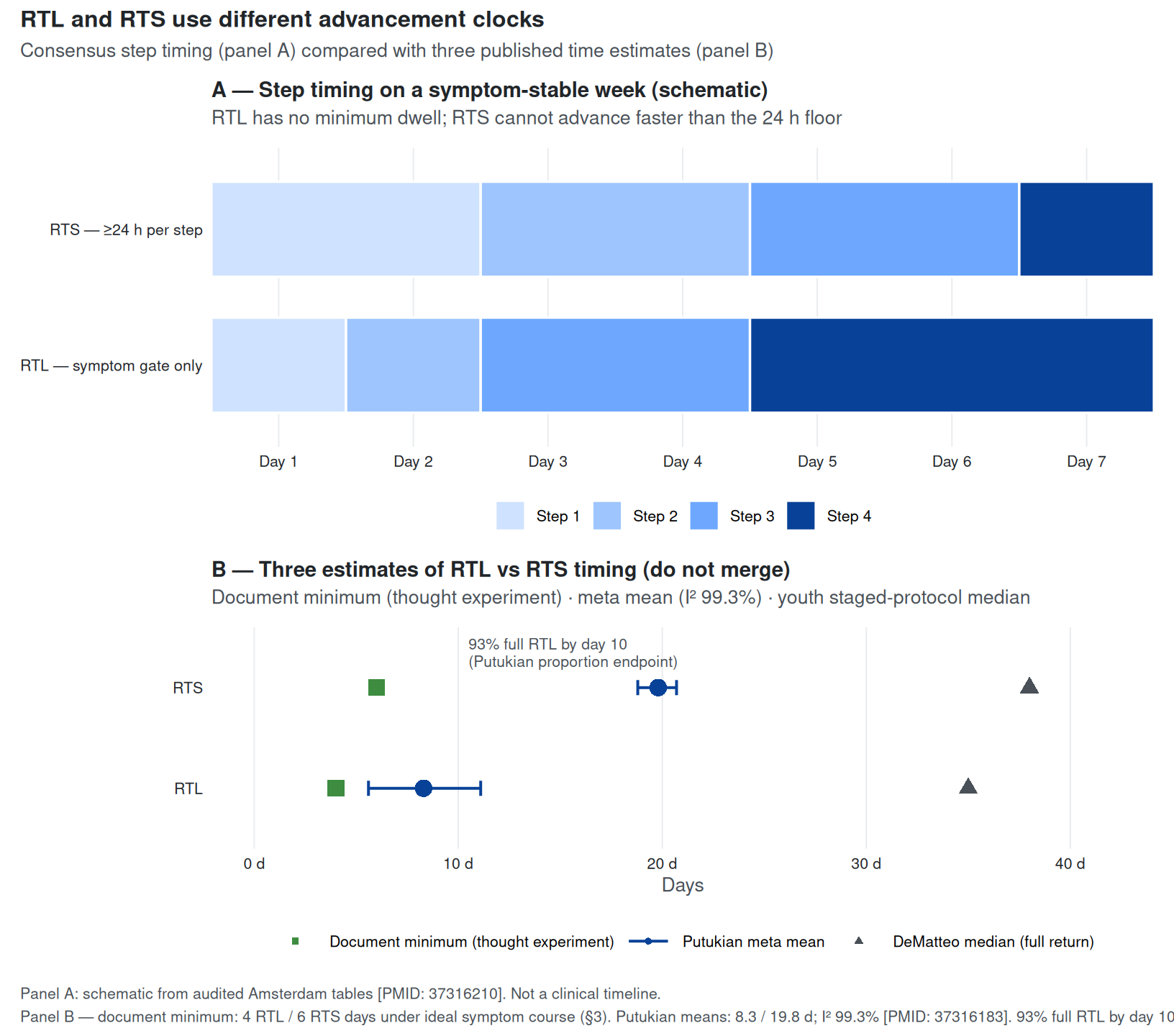
Figure 2. Panel A shows CISG step timing (RTL: symptom gate only; RTP: 24 h floor)—schematic, not a patient timeline. Panel B plots three separate estimates (do not merge): document minimum under ideal symptoms, Putukian pooled means (I² 99.3%—endpoint definitions differ across studies), and DeMatteo youth medians (full staged-protocol completion).
Amsterdam and Berlin both state that full return-to-learn should precede unrestricted return-to-sport—a hard gate on RTP steps 4–6 while RTL is still below step 4. This piece asks what happens to advancement rules when both tracks are active on the same calendar day.
No published protocol addresses same-day symptom budgeting directly. The macro rule is clear—Amsterdam: “student-athletes should complete full RTL before unrestricted RTS” PMID: 37316210; Berlin: “children and adolescents should not return to sport until they have successfully returned to school” PMID: 28446457—but those are track-completion gates, not same-day combined-load rules.
3.1 Which track gates the other when both are active?
In the early weeks of return—RTL steps 2–3 and RTP steps 1–2 simultaneously—both tracks are live and both generate daily symptom load. Amsterdam 2022 states: “while the RTL and RTS strategies can occur in parallel, student-athletes should complete full RTL before unrestricted RTS” PMID: 37316210. That sentence gates full track completion, not the session-level budget: it says nothing about what to do on a day where a 20-minute walk was symptom-free but an afternoon of reduced-load homework caused a 3/10 spike for 90 minutes.
The SOP section below proposes a practical default. Two publications provide indirect support:
Wingerson 2024 PMID: 38109187 reanalyzed the Leddy aerobic-exercise arm and reported that greater self-reported adherence and longer average session duration were associated with faster symptom resolution; lower baseline symptom severity also predicted shorter duration. The paper does not model return-to-school load or same-day school-plus-exercise budgeting—it supports documenting whether the aerobic prescription is actually being done, not a combined-load ceiling.
DeMatteo 2019 PMID: 31396150 ran RTL (school) and RTA (activity) tracks simultaneously in stages 1–3 for 139 youth patients and found that RTA stage 6 (full contact) was appropriately deferred until full school reintegration. The stages overlapped safely in lower steps; the hold was at the high-contact end. That matches Amsterdam’s explicit gate.
The default in the absence of a published rule: if either track generates >2/10 escalation for >1 hour on a given day, hold advancement on both tracks the next day. This is conservative and may slow the sport track unnecessarily for students who are genuinely ahead on RTL. If a school-side spike is clearly attributable to a discrete event (e.g., exam day) and has fully resolved, clinicians may document the cause and reassess rather than applying a mechanical hold. It is preferable to the alternative—advancing sport independently of school load—which Figure 3 shows remains common on the school track PMID: 35292472 PMID: 24925965.
3.2 Yang 2024: cognitive activity is not the hazard
One common clinical assumption in dual-track management is that cognitive load should be aggressively minimized to protect the aerobic recovery budget. Yang et al. 2024 PMID: 38346776 found the reverse in an acute SRC cohort: more moderate-to-vigorous cognitive activity was associated with faster symptom resolution (adjusted HR 1.22 per additional 10 minutes of moderate-to-high cognitive activity daily). Delayed return to school was associated with an 8% reduction in resolution rate.
This is an observational acute SRC study, not an adolescent PPCS trial, and Yang et al. note that relatively little has been reported on optimal cognitive activity intensity post-concussion. The finding does not override the ≤2/10 symptom cap from Amsterdam, but it does reframe the dual-track concern: the documented hazard is uncoordinated tracking—aerobic advancement proceeding without documentation of school-side load, so the combined symptom picture is never assembled.
A student who is advancing well on RTP step 2 aerobic sessions while sitting in RTL step 2 with mounting exam accommodations is not necessarily in a dangerous cognitive-load situation. They may be in a documentation gap where neither the sport trainer nor the school counselor knows what the other’s checklist says. That is the gap Yang 2024 indirectly supports closing—not the suppression of cognitive activity.
4. The combined-load progression gap
A review of the published concussion literature found no protocol that specifies a combined RTL + RTP load budget for progression decisions. Figure 3 shows one documented consequence: premature RTL return did not improve across two Canadian chart-review eras while RTS did. The macro coordination rules (RTL before unrestricted RTP; symptom-gated step advance) are established in the CISG consensus PMID: 37316210 PMID: 28446457. The session-level question—if school and aerobic exercise both provoke symptoms on the same day, which track’s advancement rule governs?—is not addressed in any trial or consensus document reviewed for this piece.
This gap sits at the intersection of the three logics:
If using Logic A (weekly BCTT), the treadmill test is unaffected by what happened at school that week—the prescription changes only if the BCTT threshold moved. School symptoms on Tuesday do not delay Friday’s test. This is operationally clean but clinically incomplete: a student who is struggling through RTL step 3 with daily headaches is plausibly not a good candidate for a BCTT intensity bump, regardless of what the treadmill shows.
If using Logic B (CISG step rules), the same-day cognitive load is invisible unless the clinician specifically asks. The student reports “the walk was fine,” which is true. The clinician advances the RTP step. Nobody asked about the three-hour afternoon of screen-based schoolwork.
If using Logic C (fixed ramp), session completion drives advancement automatically. The ramp schedule does not have a school-symptom input.
What fills this gap is clinical judgment and documentation practice—specifically, a dual-column format that records school-side and sport-side status on the same day. Most SRC discharge plans carry only one track’s checklist; DeMatteo 2019 reported that school and activity stages were often tracked on separate pathways in practice PMID: 31396150. Until a trial reports combined daily load with preregistered advancement rules, the field’s silence on this question should be acknowledged explicitly in the record, not papered over with a generic “advancing as tolerated” note.
Figure 3 — Premature return rates by track and era
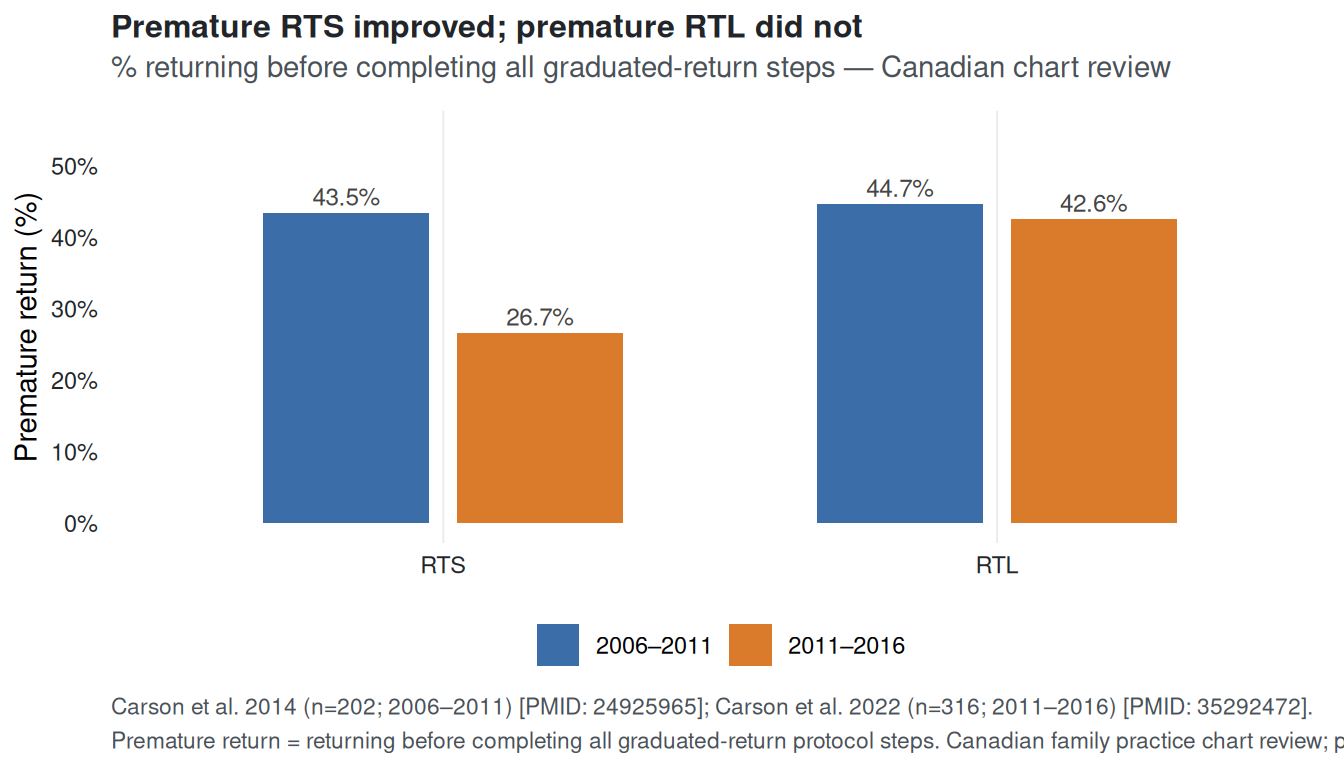
Figure 3. RTP premature return fell from 43.5% to 26.7% across the two Carson chart-review periods. RTL premature return was essentially unchanged (44.7% → 42.6%). Sport-track documentation improved; school-track documentation did not.
5. Limitations
No head-to-head trial of progression logics in adolescent PPCS. Logic A (BCTT) is derived from a trial that was not designed to compare progression rules; Logic C (Micay) was a feasibility RCT with n = 18. Logic B (CISG step rules) is consensus-derived, not trial-derived.
RTL vs RTP temporal asymmetry is read from primary CISG PDFs, not from a systematic review. The table in §1.2 applies the same four fields to Berlin and Amsterdam return-to-school and return-to-sport tables 37316210 28446457. Putukian endpoint alignment is summarized in §3. This piece does not report unpublished screening counts or adherence-audit aggregates from any ongoing review work.
Putukian meta-analytic means are not patient-level forecasts. I² 99.3% for days-to-RTL and days-to-RTP 37316183 reflects incompatible study endpoint definitions across ~278 pooled studies—not a problem fixable by averaging. The 93% full-RTL-by-day-10 proportion and DeMatteo youth medians are reported on separate layers (see §3 alignment table).
Figures 1–2 include schematic or derived elements. Figure 1 trajectories are illustrative; Logic B is not on the same y-axis scale as A/C. Figure 2 panel A is schematic; panel B includes document-derived minima (ideal symptom course only) alongside published aggregates.
Yang 2024 is acute SRC, not PPCS. The cognitive-activity finding (aHR 1.22) applies to post-acute return to learn in acutely concussed adolescents PMID: 38346776. Generalizability to PPCS—where symptom profiles differ—is not established.
Micay protocol coverage. The Micay 2018 feasibility RCT enrolled patients within 2 weeks of SRC, not PPCS. The ramp logic is relevant but the sample and timeline may not generalize to prolonged symptom patients.
No adolescent-PPCS RCT with dual-track combined outcome. All progression logics reviewed here were tested with RTP outcomes as primary; RTL was tracked secondarily or not at all.
6. SOP: dual-track progression decision checklist
Synthesizes three progression logics and CISG dual-track coordination rules for educational use only PMID: 30715132 PMID: 37316210 PMID: 30018795 PMID: 27120294 PMID: 38346776.
Three things to write down
- Pick a progression logic at the first prescription (Buffalo weekly test, CISG step rules, or session ramp)—and write it down.
- Record RTL step and RTP step on the same line every visit; school and sport advance on different rules.
- If either track flares >2/10 for >1 hour today, hold both tracks tomorrow unless you document a clear one-off cause (e.g., exam day).
Step 0 — Assign a progression logic at first prescription
| Setting | Plain name | Logic | Required at each reassessment |
|---|---|---|---|
| Clinic with weekly treadmill | Buffalo / BCTT weekly | A | New BCTT threshold → new ceiling |
| Structured PT, fixed program | PT session ramp | C | Session completion + symptom log |
| Community / school / telehealth | CISG step checklist | B (RTP: ≥24 h/step) | Daily symptom log; ≤2/10 gate |
Documenting which logic was assigned prevents the “advancing as tolerated” ambiguity from accumulating across handoffs.
Step 1 — Advance decision for each track
| Track | Advance when | Hold when |
|---|---|---|
| RTP aerobic (steps 1→2, 2A→2B) | Previous session complete; symptoms ≤2/10 at peak, resolved <1 h; not blocked by Step 3 contact gate | >2/10 for >1 h on any activity that day; or RTP steps 4–6 before RTL step 4 (see Step 3) |
| RTL (steps 1→4) | Prior step tolerated without >mild exacerbation; academic support stable | Symptom escalation on the same day as an aerobic session, even if the walk was symptom-free |
Step 2 — Same-day combined-load rule (proposed default)
This rule has no published source. It is a clinician-judgment bridge for the gap identified in Section 4:
If either track generates >2/10 symptom escalation for >1 hour on a given day, defer advancement on both tracks the next morning. Reassess after one more symptom-stable day on the lower step.
Document the reason for the hold. If RTL repeatedly blocks RTP advancement, flag for clinical review rather than silently holding—the limiting factor may need attention (academic accommodation inadequacy, exam timing, or clinical reassessment of PPCS trajectory).
Step 3 — High-contact gate
Per Amsterdam 2022 youth guidance PMID: 37316210:
No RTP steps 4–6 (team drills, contact, unrestricted play) until RTL step 4 is reached (full school day without accommodations, no concussion-related academic support).
This is a hard gate in the published consensus. It cannot be waived by logic A (BCTT test result) or logic C (session count completed).
Dual-track status line (copy to any communication)
RTL: Step __ / 4 (e.g., partial day, __ accommodations active) · RTP: Step __ / 6 · Progression logic: [BCTT weekly / CISG step rules / session ramp] · Combined-load rule applied: [yes / no] · Next reassessment: __
The HR calculator encodes intensity bands for RTP step 2. Apply within the step ceiling; do not use as permission to advance across step boundaries independently of RTL status.
Important
Educational use only. Progression rules summarized here are derived from published trials and consensus statements. They do not replace individualized medical assessment, local return-to-play law, or school board policy.
7. Closing
Three progression logics are operating in the adolescent SRC and PPCS literature simultaneously: weekly BCTT retest (test-gated, clinic-dependent), CISG step rules with a 24 h floor on RTP steps (symptom-gated on both tracks; no equivalent time floor on RTL), and session-titrated ramps (calendar-gated, program-dependent). None has been compared head-to-head in adolescent PPCS. The choice in practice is determined primarily by setting constraints—treadmill access, visit cadence, supervision—not by evidence that one logic produces better outcomes.
When both return-to-learn and return-to-sport are active, the advancement rule used on one track does not automatically apply to the other. The macro coordination rules (full RTL before unrestricted RTP) are established. The daily combined-load question—what happens to advancement when school and sport both generate symptoms on the same day—is a gap in the published literature that clinical judgment currently fills.
Series: Foundation Stack · methods · progression rules; dual-track advancement